Auckland Right-Turn Traffic Light Not Changing? How to Trigger Road Sensors (Inductive Loops)
Stuck at an Auckland intersection waiting for a green right-turn arrow? Learn how road inductive loop sensors work, where to stop your car, and how to trigger traffic lights every time.
- Target Keywords: Auckland traffic lights, inductive loop sensor, right turn signal NZ, traffic light sensor position, Auckland road rules, SCATS traffic signals
Have you ever sat in an Auckland right-turn bay watching through two or three light cycles while your arrow stays red?
Frustrated drivers often assume the traffic lights are malfunctioning, with some dangerously running the red light in sheer exasperation. In reality, modern traffic lights in New Zealand are rarely on a fixed mechanical timer. Instead, they operate on dynamic vehicle detection. If your car is not sitting on the road’s inductive loop sensor, the traffic management system simply does not know you are there.
Here is how Auckland’s traffic signal sensors work and exactly where to place your vehicle to get your green arrow on the next cycle.
1. What Are Auckland Traffic Light Sensors (Inductive Loops)?
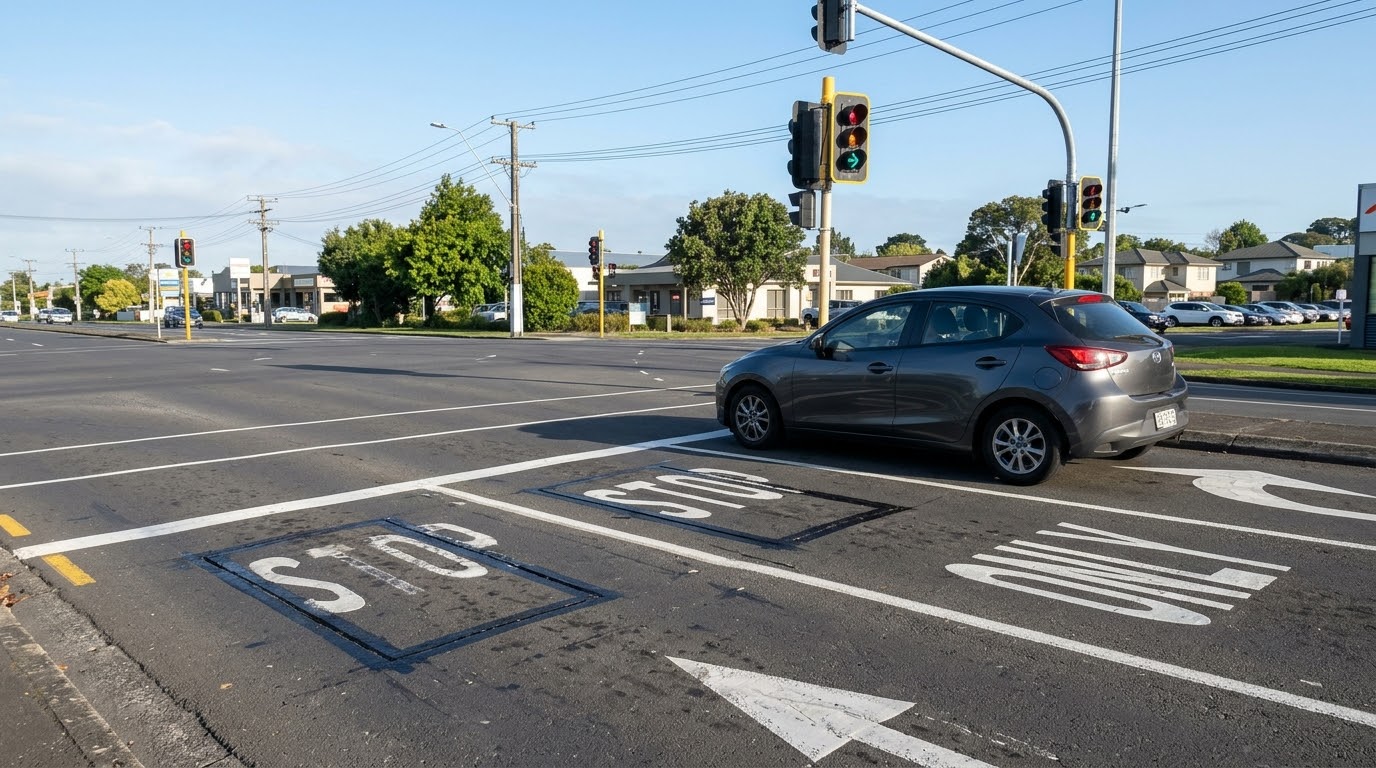
If you look at the asphalt just behind the white stop line in right-turn bays, you will notice distinct rectangular or diamond-shaped grooves sealed with black bituminous sealant. These cut marks house an inductive loop detector.
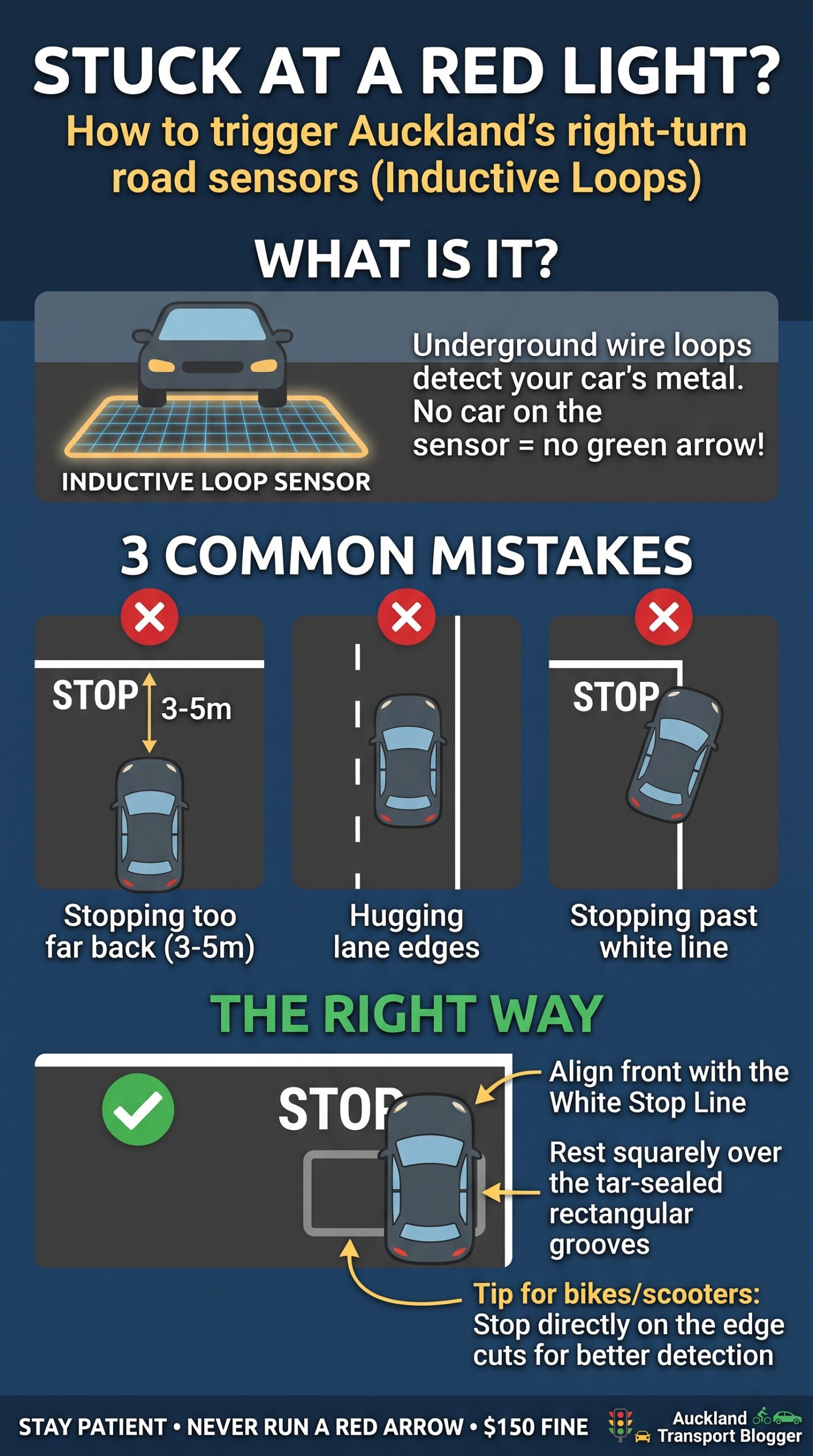
- How It Operates: A wire loop buried beneath the road surface generates an electromagnetic field. When a vehicle’s metal chassis drives over the loop, it alters the field’s inductance.
- The SCATS Connection: In Auckland, these sensors feed real-time demand data into the Sydney Coordinated Adaptive Traffic System (SCATS), which controls the city’s network.
- Demand-Actuated Phasing: During off-peak periods, late nights, or along secondary roads, the traffic controller completely skips right-turn phases unless a vehicle registers on the loop. No metal detected means no green signal.
2. Common Stopping Mistakes That Leave You Stranded
Many drivers inadvertently bypass the sensor without realizing it:
| Driver Error | Physical Position | System Reaction |
| Stopping Too Far Back | 3 to 5 metres behind the white stop line | Vehicle remains outside the electromagnetic field; phase is skipped. |
| Hugging Lane Edges | Straddling lane markings or stopped off-centre | Metal mass misses the loop core, failing to trigger sufficient inductance change. |
| Overrunning the Stop Line | Front wheels over the stop line and pedestrian crosswalk | Vehicle rolls past the sensor grid before registration finishes. |
Drivers who stop several metres behind the line at quiet suburban junctions can hold up an entire queue indefinitely. Unless a trailing vehicle pulls close enough to compress the loop, the right-turn arrow will not fire.
3. How to Stop Correctly Over Traffic Light Sensors
Triggering the green light reliably takes only a few practical habits:
- Target the White Stop Line: Bring your front bumper directly up to, but not over, the solid white stop line. The primary detection loop is cut immediately behind this marking so that standard engine blocks and axles sit squarely above the coil.
- Scan the Bitumen for Saw Cuts: As you slow into the bay, glance down for the tar-sealed rectangular frame on the road surface and roll straight onto its center.
- Tips for Motorcyclists and Scooters: Two-wheelers have far less ferrous metal mass than cars. Instead of stopping in the dead center of the box, position your tyres directly along the cut grooves (the perimeter edge), where the loop wires are concentrated and magnetic sensitivity peaks.
4. What to Do If the Right-Turn Signal Refuses to Change
- Readjust Vehicle Position: If an entire cycle passes without an arrow, gently nudge your vehicle forward or backward by 30 to 50 cm while keeping behind the line. This movement often forces a fresh inductance spike in the SCATS controller.
- Never Run the Red Arrow: Auckland Transport and NZ Police operate red-light safety cameras across key arterial intersections. Proceeding through a solid red arrow incurs a $150 infringement fee, points, and severe collision risks with oncoming through-traffic.
- Use an Alternative Exit: If a faulty sensor genuinely fails to detect your car, stay patient. When the through-lane phase allows it and lane switching can be executed safely, abort the turn, proceed straight or turn left, and perform a legal U-turn or around-the-block diversion down the road.
Official Resources & Further Reading
- NZ Transport Agency (Waka Kotahi): Traffic Signals and Intersection Guidance
- Auckland Transport: Traffic Signal Operations and Red Light Safety
- The New Zealand Road Code: Giving Way at Intersections Controlled by Traffic Signals